
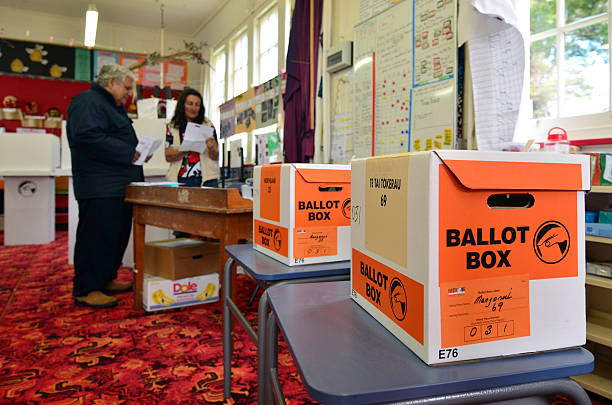
The results of New Zealand’s general election on November 7 are yet to be finalised, as election officials are recounting the ordinary and special votes.
Receiving special overseas votes, which are legally allowed to be received 10 days post-election, are being checked to see if anyone has voted more than once, and to ensure the voter is enrolled.
Currently, the National Party has won 42 seats in the House of Representatives, the Labour Party has won 36 seats, and 53 seats have gone to minor parties, including the Green Party and ACT New Zealand.
A total of 66 seats are needed to secure a majority in the New Zealand Parliament. New Zealand has 131 seats rather than its usual 120, due to 11 overhang seats created by its voting system of mixed-member proportional (MMP).
Under MMP, voters cast 2 votes, 1 vote for a local candidate and 1 vote for a political party. While a party’s overall share of parliament is dictated by the party vote, if a party wins more electoral seats than its share of a party vote, the additional seats are retained, creating overhang seats.
Combined with its coalition partners, ACT New Zealand and New Zealand First, the National Party would hold a narrow majority of 67 seats.
During the election, the National Party promised to allow first home buyers to buy houses with a 5% deposit, not introduce new taxes, pass tougher sentences for sexual offences and invest an additional $604 million in Pharmac’s budget to expand access to new medicines.
The Labour Party promised to invest $4 billion into building at least 6,000 additional social housing units over four years, allow for 3 free doctor’s visits a year, cut student debt by 10% and ensure no upfront cost and low-interest loans for renters and homeowners to install solar.
The Green Party’s promises included requiring the government budget process to be consistent with limiting global warming to 1.5 degrees, regulation of artificial intelligence, building tens of thousands of public homes, lowering taxes on low and middle-income earners, and raising the top income tax rate.
ACT New Zealand campaigned on creating a one-stop consenting process to fast-track new competitors in the supermarket sector, making cryptocurrency gains tax free when it has been held longer than a year, investing $400 million over four years to retain more GPs in New Zealand and scrapping the net zero 2050 target.
Prime Minister Christopher Luxon of the National Party congratulated the Labour Party on a “very hard-fought race” before addressing his colleagues, saying “whatever the final count, we are incredibly proud of each and every one for you”.
The Leader of the Opposition, Chris Hipkins of the Labour Party, has shown no signs of conceding the election, but said the “next parliament is going to require all of us to compromise, to work together and to find a common ground”.
The results of the election are due to be finalised on November 27th.



Leave a Reply