
YUMI [‘jumi”] is a very strong Bislama word of saying ‘we’. There is no ‘I’, there is only ‘we’ – Solomon Yeo
YUMI The Whole World, follows the story of three students taking the world’s biggest issue to the world’s highest court.
University of the South Pacific law students, Solomon, Vishal, and Romabeth want the International Court of Justice to give an advisory opinion about the legal obligations of states are in addressing the climate crisis.
For these students this is more than a climate change movement, it is a fight for the survival of their island homes and their people.
Elders featured in Yumi show viewers the real-world impacts of rising sea levels.
One elder’s home has been swallowed by the rising sea water, while the Vishal’s grandmother explains that papaya trees no longer grow properly.
The DIY documentary captures every step of their journey organising students globally to petition world leaders to support the cause.
From the laugh-out-loud awkwardness of technical issues to the gut-wrenching setbacks, the audience cannot help but feel every high and low.
Yumi The Whole World is a film that should be on every student’s must watch list as it highlights what student organising can achieve.

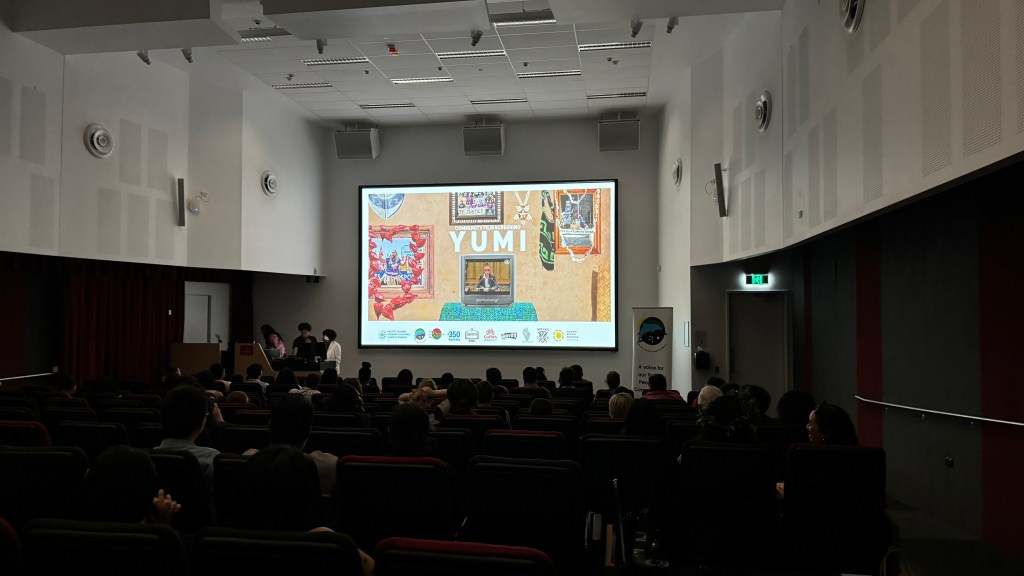
Community Screening of Yumi
The Griffith Journal was invited to attend the first Queensland screening of Yumi by the Pacific Islands Council at Griffith University’s Southbank campus.
Also hosting the event were 350.org.au, 350 Pacific Queensland, Pacific Islands Students Fighting Climate Change, and The Pasifika Future Ancestor’s Program.
The event was MC’d by Griffith University student and committee member of the Solomon Islands Brisbane Community Keren Hou.
A Q&A Panel of your Pacific Island changemakers invited attendees to think about how they can continue the fight against climate change.
Panellists included Zhanae Dodd, Nauna Lelai, and Vuki Taalolo Felaugaina Tupai and the panel moderator was Iree Chow Radclyffe.
After the panel, attendees were invited to share a traditional meal.
On the menu was a pumpkin and lamb dish, Kalo (taro) with coconut cream and coconut cream buns.
Article written by Emma Standen and produced by Riley O’Leary.
Photos were taken by Stefan Armbruster.


 The Griffith Journal
Leave a comment