
Written By Lili Galvin, Student Journalist for the Griffith Journal
Edited and Co-Produced by Emma Standen
23 August, 2025
Key Article Summary
- This article provides a transcript of an interview completed with SRC committee member and meeting organiser, Kore Opie, from yesterday’s Student General Meeting (SGM).
- The SGM was held to facilitate an opportunity for students to vote in the National Student Referendum on Palestine.
- It provides a breakdown of the interview, both questions and answers, with fact-checked comments with related sources.
- Showing that through Kore Opie’s answers, the SRC and student body are committed to taking a stand against the Government to have their motions met and voices heard.
GRIFFITH University’s Student General Meeting, a Vote for Palestine, was held last Wednesday 20th of August, to facilitate an opportunity for Griffith Students to vote in the National Student Referendum on Palestine.
Emma Standen and I had the opportunity to interview SRC committee member and event meeting organiser, Kore Opie, to help expand on the significance of this movement.
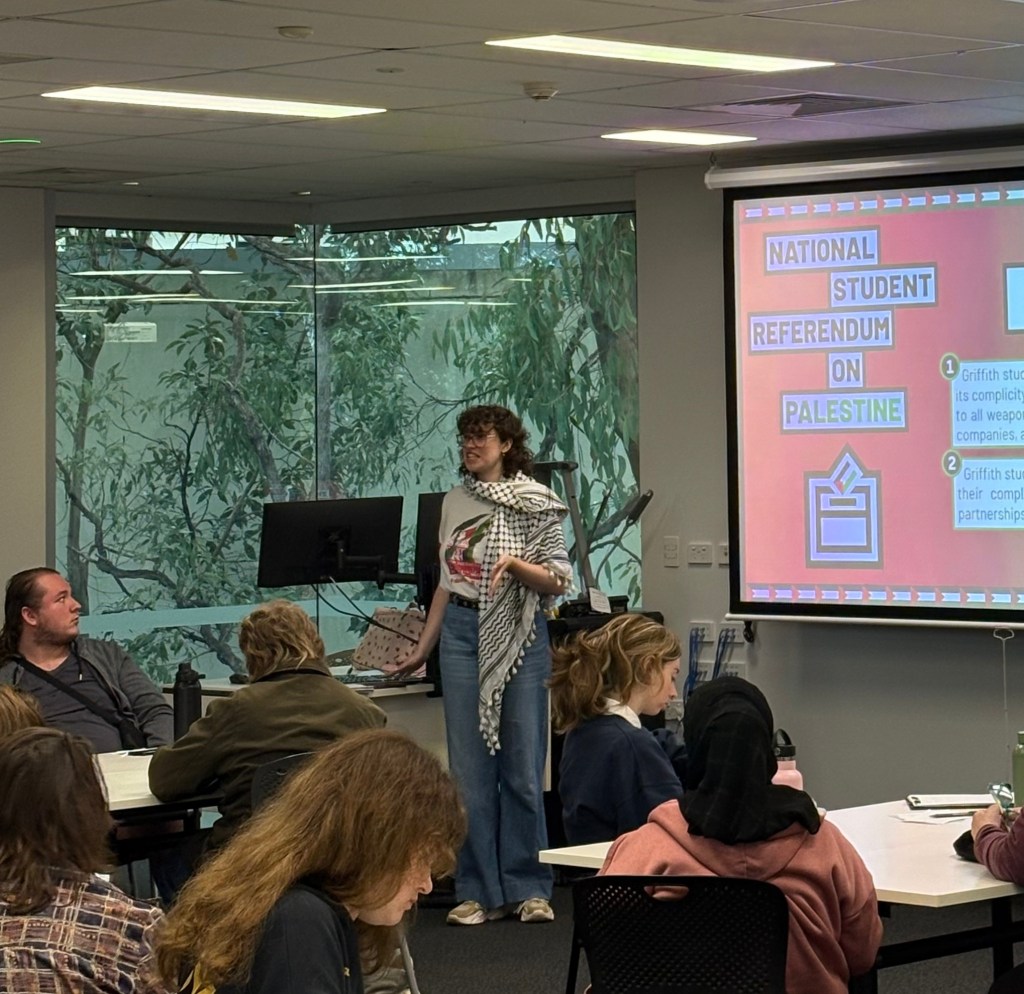
Q: What is the point of this vote and meeting if the Government is already condemning Israel?
A: “I don’t think the Government is actually condemning Israel. I think the government has said they are going to recognise the state of Palestine, but that actually means nothing. I think it is far too little, far too late. Over 60,000 Palestinians have been massacred, hundreds are starving to death, no aid is being allowed in the country, and our government isn’t doing anything concrete that could actually stop any of this. Our government is the one that supplies vital F-35 parts, the bomb bay doors, the things that actually make it so that the bomb can drop from those planes, are only produced in Australia. Australia has a 900-million-dollar weapons contract with Elbit Systems an Israeli company. All of these things, cutting the two-way arms trade, sanctioning Israel, expelling the ambassador, these are concrete things are government can do to stop the genocide. But they are not doing any of that; that’s why we are having this meeting, to put those demands forward to say that, well, thousands of students are going to come out and take a stand and say that words aren’t actually enough.”
Prime Minister Anthony Albanese, during a press conference on August 11 in Parliament, confirmed that Australia will recognise the State of Palestine.
“Today, I can confirm that at the 80th Session of the United Nations General Assembly in September, Australia will recognise the State of Palestine,” the Prime Minister stated.
“Australia will recognise the right of the Palestinian people to a state of their own, predicated on the commitments Australia has received from the Palestinian Authority.
“We will work with the international community to make this right a reality.”
During that same conference, Albanese announced that Australia would be a part of a globally coordinated effort to build a two-state solution.
“Australia is making this statement today, following our Cabinet meeting, as part of a coordinated global effort, building momentum for a two-state solution,” Albanese stated.
“A two-state solution is humanity’s best hope to break the cycle of violence in the Middle East and to bring an end to the conflict, suffering and starvation in Gaza.
“The international community’s vision for a just and lasting peace in the Middle East always encompassed two states living side by side with internationally recognised borders, a State of Israel and a State of Palestine with security for the people of both nations.”
But to activists like Kore Opie, this statement is not enough, as information from Elbit Systems, an Israeli-based weapons and vehicle company, in February 2024, revealed that an Australian subsidiary of Hanwha, the Korean defence company, awarded them an AUD 900 million contract.
“It [Elbit Systems] was awarded a contract worth approximately $600 [USD] million to supply systems to Hanwha Defence Australia for the Australian Land 400 Phase 3 Project,” the company wrote.
“This project aims to deliver advanced protection, fighting capabilities and sensors suite to the Redback Infantry Fighting Vehicles (IFV) for the Australian Army.
“The contract will be performed over a period of five years.”
Further, there has been speculation regarding Australia’s involvement in the distribution of F-35 lethal fighter jet parts to Israel.
However, Deputy Prime Minister Richard Marles denied any involvement to ABC TV on August 10.
“Let’s be clear: we don’t supply weapons to Israel,” Marles stated.
“We’ve seen a lot of misinformation in relation to what Australia is doing here.
“The fundamental point is that we are not supplying weapons to Israel.”
A Greens Party spokesman, David Shoebridge, told the Guardian that these statements are meaningless.
“Australia is a key part of the F-35 fighter jet program. We are the only place in the world that makes parts like the bomb bay doors and we operate as one of the few regional distribution hubs,” Shoebridge said.
Q: Do you know if Griffith University has any ties to weapon companies? If you do, do you know what those ties are?
A: “I’m not too well-versed in Griffith’s particular ties, they are not posted on their website like other universities. But I do think one thing is that the engineering degree is kind of geared towards the military and the mining industries. These are the key kinds of industries students are pushed towards. So, I think our university has ties in that regard to push students towards those sorts of companies. Unfortunately, Griffith doesn’t have a huge list of companies like UQ and QUT have on their websites.”
There is no current evidence that Griffith has any ties with weapon companies.
When The Griffith Journal asked the Vice Chancellor’s Office if the university had ties to weapons companies, we received this statement from the media relations team.
“Griffith University supports the rights of students to discuss, debate and take positions on global affairs.
Griffith is not involved in research which supports the development of weapons, armaments or lethal systems. “

Q: What happens after this vote? What are you trying to achieve through the Student General Meeting?
A: “I think the point of the SGM (Student General Meeting) is about students having their voices heard and to take a stand on the right side of history. But we don’t just want it to end here. The most important thing is that as many people as possible come out to the National Day of action on August 24th, and our march here in Brisbane is going to be on the Story Bridge, and I think all of this is about mounting public pressure to get as many people as possible to take a stand and say the majority of people in society do not stand by when a genocide is carrying out. We want our own government to also take that side.”
Griffith University is the first of many major universities to facilitate a meeting for students to debate and vote in the National Student Referendum on Palestine.
The referendum and meetings are being organised by The Students for Palestine movement.
Q: What are the next steps now that the votes are in?
A: “I think the next step is to get more students involved in the campaign, not just on our campus and on Students for Palestine, but around the country, taking to the streets to put our demands to make sure they are heard. The next is that people should come out and march on the Story Bridge and make it a scene that cannot just be ignored.”
The nationwide march for Palestine was showcased during the meeting to encourage everyone to get involved.
In Brisbane, the march for Palestine is happening over the Story Bridge this Sunday, August 24, at 1 pm.
Q: Some people are under the impression that Socialist Alternative is running these national student general meetings to boost its numbers before going into elections, that are coming up at the end of this year. What do you have to say about that?
A: “I think that’s just a really silly question, actually. Social Alternative has stood on the side of Palestine for decades; we have always stood with Palestine. We have been a key part of organising around the country. I think it has nothing to do with student politics; it’s about standing on the right side of history and about taking a stand against genocide. The reason we are calling these student general meetings around the country is because there is a political moment right now. And that is that there is mass starvation happening in Gaza, it is one of the most horrific atrocities carrying out. I don’t think we can stay silent, and this is why we are taking a stand.”
Stay tuned to the Griffith Journal for upcoming updates on this weekend’s march and see how fellow Griffith University students are getting involved.

 The Griffith Journal
Leave a comment