By Riley O’Leary for the Griffith Journal
26 April 2025
The 2025 Federal Election is set to be one of the closest in a long while, taking place on May 3, 2025. This election will all 150 seats in the House of Representatives (down from 151)contested, as well as 40 of the 76 seats for the Senate.
What is the state of play?
Government
The current government is led by Prime Minister Anthony Albanese of the Australian Labor Party (ALP). The ALP holds 77 of the 151 seats in the House of Representatives. The ALP also holds 25 of the 76 seats in the Senate.
Opposition
The opposition consists of four parties, who form the Coalition. These four parties are the Liberal Party, the National Party, the Liberal National Party (LNP), who operate in Queensland only, and the Country Liberal Party (CLP), who operate in the Northern Territory. The Coalition holds 53 seats in the House of Representatives and hold 30 in the Senate.
Crossbench
The crossbench consists of minor parties which do not form government and aren’t the opposition. There are 19 crossbench MPs in the House of Representatives prior to the election. This consists of four Greens MPs, Bob Katter of the Katter’s Australian Party, Rebekha Sharkie of the Centre Alliance, and 13 independents. Of these independents, seven are funded by political fundraising organisation Climate 200. These MPs are known as ‘teal independents.’
There are 21 crossbench senators, made up of 11 from the Greens, two from One Nation, as well as one representative from each of the United Australia Party, Jacqui Lambie Network, Australia’s Voice and People First parties. There are also four independent senators: David Pocock, Tammy Tyrell, Lidia Thorpe and David Van.
What will happen this election?
Please note: Any predictions made below are my opinion based on available evidence at the time of writing. Given the close nature of this election, the predicted results given below could be incorrect, and should not be taken as fact. This is just one of many possible scenarios.
Many polls, from November last year until late February this year had the Coalition ahead on the two-party preferred vote. However, recent polling puts the ALP in a superior position, with the latest Newspoll giving the ALP 52 per cent of the two-party preferred vote.
However, this does not necessarily translate into the ALP forming majority government. To do so, they must win 76 of the 150 lower house seats. If they, or the Coalition, do not achieve this, it is known as a hung parliament, where major parties must negotiate with the crossbench to form government, known as a minority government. The last time this happened in Australia was in 2010.
With the rise of minor parties and community independents, forming an outright majority government may be tough. This is especially true when you consider that neither major party is polling at over 35 per cent of the primary vote, with approximately one-third of voters to vote for a minor party or independent.
Polling data of the last month was collated to form an estimation of how each party will fare in the 2025 federal election. This includes polls conducted by research organisations, as well as exit polls from early voting.
The House of Representatives
In order to win a majority government, the Coalition will need to win an additional 23 seats to what they have now. This will be largely impossible to achieve if they are only to win 48 per cent of the two-party preferred vote.
Some key Coalition targets, which they do not currently hold, include the seats of Gilmore (ALP), Mackellar (IND), Kooyong (IND), Chisholm (ALP), Goldstein (IND), Aston (ALP), Curtin (IND), Lyons (ALP), Lingiari (ALP), Robertson (ALP) & Paterson (ALP). Of these 11 seats, of which the Coalition would need to win pretty much all, plus another dozen, whilst retaining all other seats they currently hold, they are only projected to win three. They are projected to make a net gain of nine seats in total, including retaining seats lost in by-elections and winning new seats which have been created or altered after the latest electoral re-distribution, such as the seat of Bennelong.
However, the ALP are also unlikely to form a majority government. In order to win majority, they would need to retain almost every seat they won at the 2022 federal election. With the Coalition expected to pick up a handful of these seats, and with community independents unlikely to lose favour, this will be a tough task. The ALP are expected to lose a net total of three seats, including losing seats such as Lingiari (NT), Bennelong (NSW) & Gilmore (NSW).
The Greens are expected to lose two seats in Brisbane, with the Coalition and Labor picking up one each. Independents are also expected to lose three seats. With Bob Katter and Rebekha Sharkie expected to retain their seats, this will equate to 14 crossbench MPs, who will gain the balance of power in the House of Representatives.
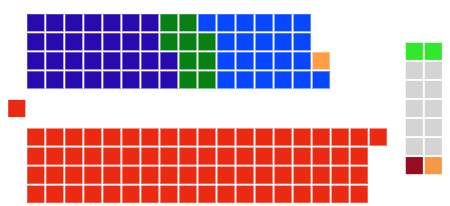
This translates to the following expected makeup of the House of Representatives:
Labor Party – 74 seats
Coalition – 62 seats
The Greens – 2 seats
Katter’s Australian – 1 seat
Centre Alliance – 1 seat
Independents – 10 seats
How the House of Representatives is expected to look after the election*
The expected electoral map following the election*

What about in Brisbane?
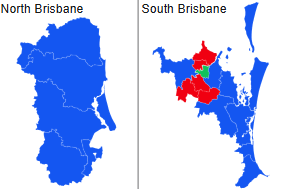
Brisbane shapes as a key battleground for the ALP, LNP and the Greens.
The LNP holds the vast majority of seats in Brisbane, including Opposition Leader Peter Dutton’s seat of Brisbane. Despite his margin being small at the 2022 federal election, he is expected to retain his seat.
The single Greens seat is the seat of Griffith – expected to be retained by Max Chandler-Mather. However, directly to the north is the seat of Brisbane. Won by Greens MP Stephen Bates on preferences in 2022, this seat is expected to be picked up by Labor in 2025. Similarly, to the west, the seat of Ryan is expected to be won by the LNP, removing current Greens MP Elizabeth Watson-Brown from parliament.
What would happen next?
With no clear majority, both major parties would need to negotiate with minor parties for confidence and supply, until they reach the magic 76. If the above scenario were to happen, it is all but certain that the ALP would win government, as the Greens would not support the Coalition in a hung parliament.
While many of the teal independents would me more ideologically aligned with the Labor party, especially socially, many come from seats that were traditional Liberal strongholds. It is hard to predict with whom they would align, and this would likely hinge on what each party promises them in the event of a hung parliament.
In the event that two or more independents were to align with the Labor party, they would likely go down that route to avoid working with the Greens. Prime Minister Anthony Albanese has ruled out doing a formal deal with the Greens, and as such would be reluctant to enter into any form of minority government with them.
However, if absolutely necessary, the Greens will be enough to get the ALP over the line and for Anthony Albanese to remain as Prime Minister of Australia.
The Senate
The Senate is not expected to change to dramatically, with only 40 of 76 senators up for election. The ALP are expected to gain one seat, in Queensland, whilst the Coalition is expected to pick up one seat in each of Queensland and Victoria. This may come at the expense of Malcom Roberts (One Nation) and Gerard Rennick (People First) in Queensland, and independent David Van in Victoria.
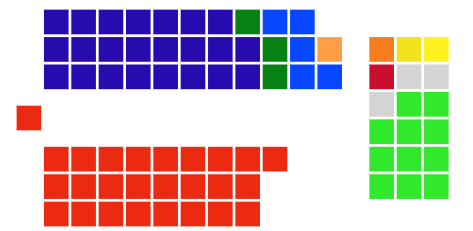
This translates to the following expected makeup of the Senate:
Labor Party – 26 seats
Coalition – 32 seats
The Greens – 11 seats
Pauline Hanson’s One Nation – 1 seat
Jacqui Lambie Network – 1 seat
United Australia Party – 1 seat
Australia’s Voice – 1 seat
Independents – 3 seats
How the Senate is expected to look after the election
Expected Senatorial elections map*
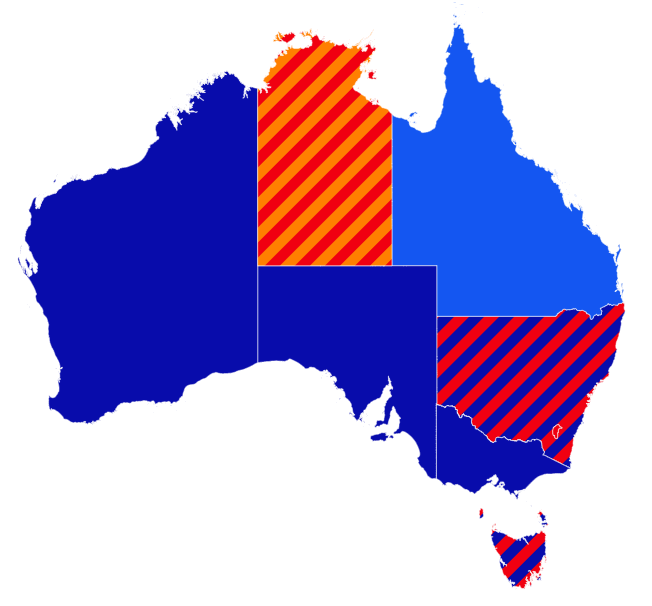
NOTE: The party which wins the most seats per state is highlighted: this does not mean they retain all six seats.
* Key for electoral map and chamber:
House of Representatives
Red – Australian Labor Party
Dark Blue – Liberal Party
Light Blue – Liberal National Party
Dark Green – National Party
Orange – Country Liberal Party (Northern Territory seat of Lingiari) and Centre Alliance (South Australia seat of Mayo)
Light Green – The Greens
Maroon – Katter’s Australian
Grey – Independents
Senate
Red – Australian Labor Party
Dark Blue – Liberal Party
Light Blue – Liberal National Party
Dark Green – National Party
Orange – Country Liberal Party (Opposition) and Pauline Hanson’s One Nation (Crossbench)
Light Green – The Greens
Maroon – Australia’s Voice
Yellow – Jacqui Lambie Network (Dark) & United Australia Party (Bright)
Grey – Independents

 The Griffith Journal
Leave a comment